
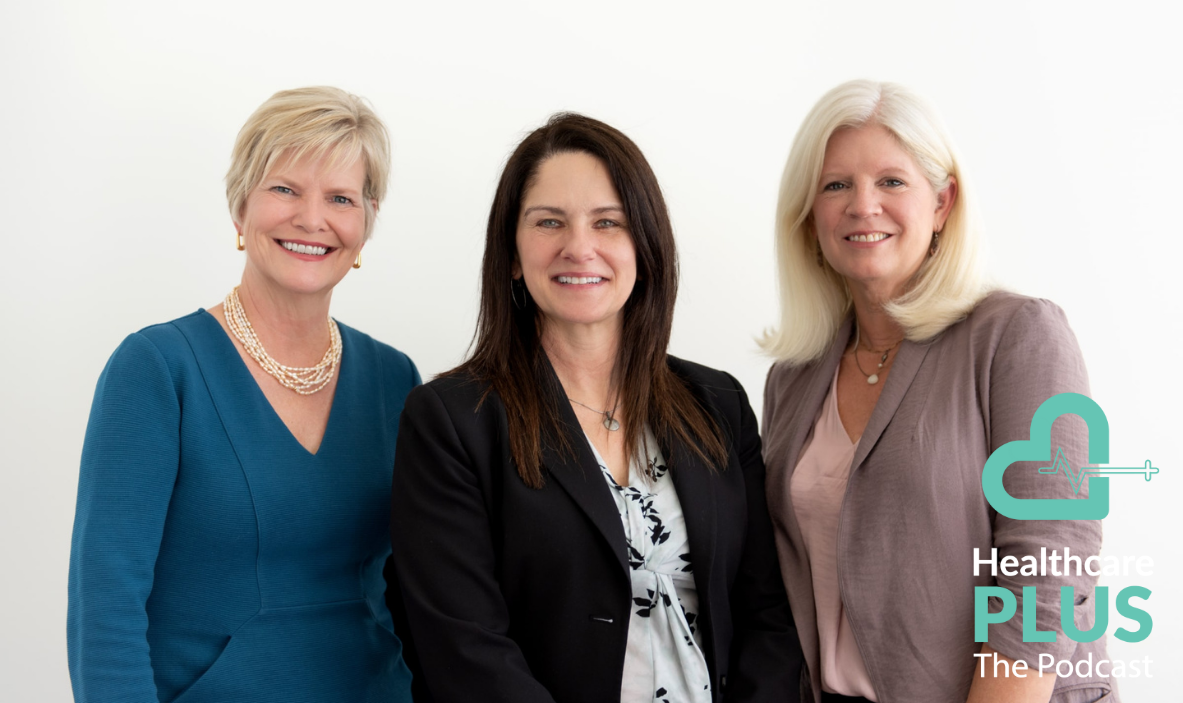

When the founders of uLeadership—Kay Kennedy, Lucy Leclerc, and Susan Campis—met in 2019, they were seasoned nurse executives who had spent years working all day and night to serve teams and patients. Then they hit a wall. “We were at a point in our career where, quite honestly, we felt a little burned out,” says Leclerc. “We were high level, overachieving work all day and night type leaders, and that’s probably part of why we were successful. And we realized that at some point in all that success, we had forgotten something or someone, and that was ourselves, and we came together.” Their response wasn’t to step back. It was to start a research journey that would become uLeadership and, now, a newly announced partnership with Healthcare Plus Solutions Group (HPSG).
In this special episode of the Healthcare Plus Podcast, hosts Dan Collard and Quint Studer welcome Kay Kennedy, Lucy Leclerc, and Susan Campis to share the origin, evidence, and impact of human-centered leadership, and what the HPSG + uLeadership partnership makes possible next.
From research question to framework leaders can use. The team’s starting point was simple and bold: ask nurses “from bedside to boardroom” to describe two leaders they’d known. The first was to “describe the leader that you’ve had or you now have, that you would follow to the ends of the earth,” shared Leclerc. “What does that leader look like? ” The second: “describe the leader who you’ve had, who made you want to leave a position or an organization or nursing itself. What we decided to do was to be affirmative disruptors and describe the ends of the Earth leader,” Leclerc says. “So that ends of Earth leader translated in our research into human-centered leadership and that’s where it all began.” Published in the Journal of Nursing Management, the research surfaced consistent patterns of behaviors that build trust, well-being, and results.
Not a “one and done”—a long game that sticks. What distinguishes the approach is persistence. “It isn’t a one and done, flavor of the month, type of leadership program that we do. It’s something that sticks and grows over time,” shares Leclerc. She tells the story of catching up with a mid-level nurse leader they partner with who shared that his director had become more intentional with relationships, was building authentic presence, and—most importantly—was modeling well-being in ways that gave the team permission to do the same. Human-centered leadership becomes a shared mindset: persistent, consistent, and practical.
Outcomes leaders care about. From the start, uLeadership’s work showed measurable movement on the metrics that matter. “One of the clearest outcomes from really out of the gate has been engagement,” says Kennedy. “We’ve also seen improvements in retention, both leader retention and staff retention. We have seen increases in staff satisfaction, and we have been thrilled to see increases in patient experience, and that’s particularly on those questions that have to do with communication and with teamwork.”
A movement grounded in humanity and hope. Human-centered leadership resonates because it reflects how people actually experience leadership. Campis recalls a keynote where a nurse leader approached her afterward with tears: “She said, ‘I was on the verge of leaving nursing, I’m exhausted, I’m overwhelmed, and I really lost sight of my purpose.’ And she said, ‘I just felt like I couldn’t do it anymore.’ And then she sort of paused, and she said, ‘But after hearing your story and learning about human centered leadership, I feel hopeful again.’ That’s really what it’s all about for me. If we can just make that one difference with one person, and if that person can feel seen and supported and inspired, then maybe they’ll spark change in their environments. And as we often refer to, the butterfly effect. And you know, if that one small flap of the of the wings, that ripple effect starts. So that’s the memory that I hold really dear and close to my heart.”
That human impact is also why belonging is rising on the team’s research agenda. As Leclerc notes, sense of belonging is now a prominent engagement dimension closely tied to retention and team performance. “The sense of belonging is something that we really want to explore, when you think about the upholder in human-centered leadership, it’s that idea of recognizing humanity in everybody on the team and in the patients in the community and truly seeing them. So that’s what we’re excited about for the future,” shares Leclerc.
Turning evidence into everyday practice. Their book Human-Centered Leadership in Healthcare: Evolution of a Revolution translates their research into behaviors leaders can practice today. “Might sound like rainbows and unicorns, but how do you put it into action?” says Leclerc. “How do you make this come to life and become a reality for people? So that was really the essence of the book and what we wanted to communicate.” Practicality is a throughline—checklists, coaching moves, and ways to hardwire habits without overwhelming already stretched leaders.
What the HPSG + uLeadership partnership makes possible. Values, mission, and purpose are tightly aligned. “We are going to have the opportunity to have this exponentiated impact,” says Kennedy. “That is just an absolute dream come true for us, because all along, it’s been about purpose. It’s been about impact. And here we feel like we have the opportunity to just bring that to life.”
Leclerc adds a vivid metaphor for the future: when the winds change, some build walls and some will build windmills. “I would love to see is to see us building windmills around the world…that we can harness the power of our energies together and synergize.”
If you want leaders who feel replenished and teams people want to join and stay on, this episode is for you. Click here to listen to the full conversation.
About Kay Kennedy, DNP, RN, NEA-BC, CPHQ, FAAN
Dr. Kay Kennedy is a nurse executive, educator, and entrepreneur. By combining a love for nurses, patients, and quality improvement, she has led large nursing teams to create healthy work environments; satisfied patients; and consistent, high-quality care. Kay has held multiple leadership roles, from the bedside to chief nursing officer. She holds an adjunct associate professor role at Emory University School of Nursing along with other adjunct appointments at Massachusetts General Hospital Institute of Health Professions and Case Western Reserve University. Her goal as a leader is to ignite innovative problem-solving, develop others to be their best, and lead by serving others.
About Lucy Leclerc, PhD, RN, NPD-BC
Dr. Lucy Leclerc is a dedicated nurse leader, nurse scientist, entrepreneur, and professor with over 30 years of diverse nursing experience. Early in her career, she spent time as a bedside nurse in high-risk labor and delivery before falling in love with nursing leadership as an officer and flight nurse in the United States Air Force Reserve. She is a lifelong learner and received her PhD from Medical University of South Carolina in 2010. She teaches all levels of nursing students, from undergraduates to DNP students. Her research focuses on generation of contemporary nursing-specific leadership models.
About Susan Campis, MSN, RN, NE-BC, NBC-HWC
Susan Campis is a nurse executive, health and wellness coach, and entrepreneur. Susan is a nurse leader whose passion for coaching and mentoring others helped produce successful and engaged nursing teams throughout her career. As a nurse leader, Susan understands the importance of a safe and healthy work environment and worked to create a culture of excellence, trust and caring where her team could perform at their best, ensuring quality care and patient safety. Susan cares deeply for the health and well-being of healthcare professionals, and, as a health and wellness coach, her goal is to work with others to help them reach their full potential.
About uLeadership®
uLeadership is the vision of three healthcare executive leaders with decades of bedside nursing and nurse leadership experience. In coming together, they recognized that each one had experienced successful leadership journeys but had left themselves and their self-care out of the equation, which led to burnout. They now understand effective leadership starts with you, but it’s not about you!
By embracing authenticity, courage, inclusiveness, and respect for others, the attributes of Awakener, Connecter, and Upholder develop and emerge. Nurse leaders incorporate the skills of cultivating people (Awakener), building community (Connector), and recognizing the humanity in others (Upholder) into their nursing leadership practice. Nurse leaders who embrace these attributes have the ability to create and sustain cultures of excellence, trust, and caring, which lead to sustained and positive outcomes.