
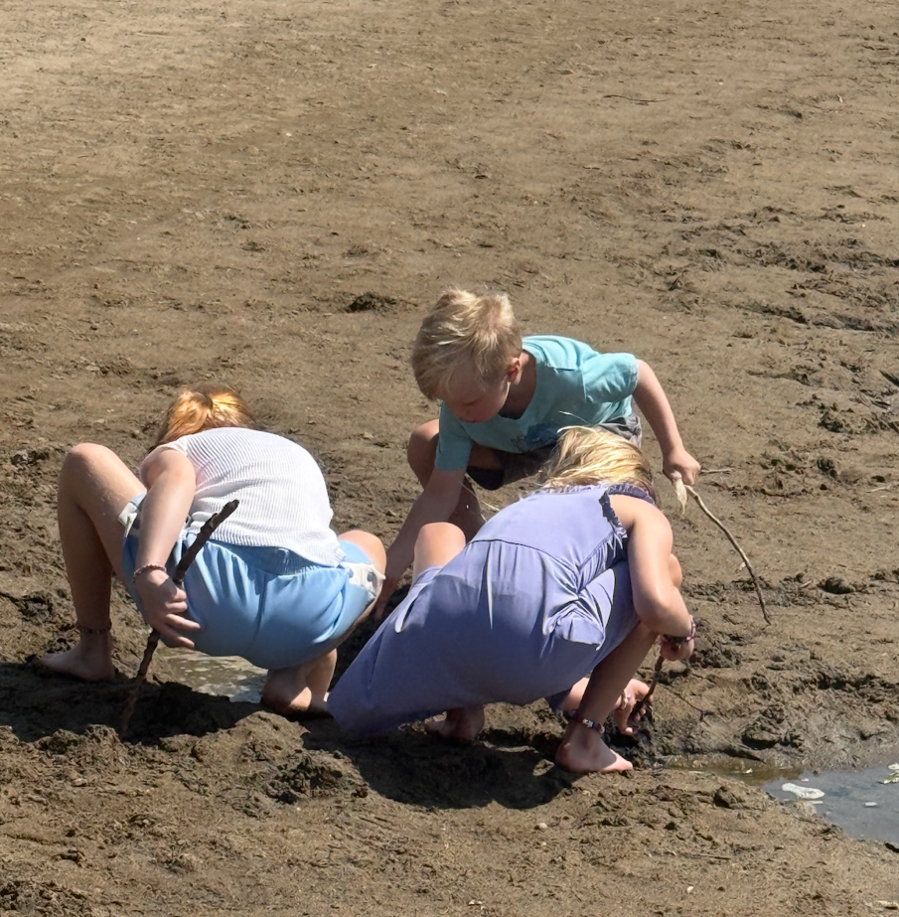

Recently my grandchildren, whom I call the “littles,” taught me an important leadership lesson. We were walking along a beach without any beach toys, shovels, or fishing gear. They really wanted to go fishing, and my response was, “We can’t; we don’t have any bait or fishing poles.” The littles heard a design problem: If we can’t get to the fish, we will bring the fish to us!
Immediately they decided to build a reservoir. They reasoned that they could use their feet to guide the fish into it and catch them without any fishing equipment. Armed with sticks, they began building. Process improvement happened without fanfare: no meeting, no whiteboard, no committee. The location and size were debated by the three of them, causing a shift in approach along the way.
They never did motivate any fish to change location, but the excitement of possibility captured their enthusiasm and generated immediate effort.
Yes, the project itself failed, if we’re scoring by the original goal of catching fish. But the littles did not experience failure. Why? Because the goal shifted the moment the sticks were found. It wasn’t really about catching fish anymore; it was about seeing what was possible with what they had. The enthusiasm wasn’t a byproduct of success; it was the success.
“Do what you can, with what you have, where you are.” These are the words of Theodore Roosevelt. Without knowing it, my grandchildren were living that adage on the beach that day. They didn’t have bait or poles. They had sticks, sand, and each other, and that turned out to be enough to start.
This is a good lesson for us in healthcare.
What the littles showed me was true resourcefulness. It was problem-solving stripped of the assumption that you need the “right” tools before you’re allowed to begin. They didn’t ask whether the plan would work. They asked what they had and what they could do with it.
Too often in healthcare, we wait for the perfect moment. We obsess over whether we have the right supplies, the right staffing, the right budget line, the right committee before we’ll let ourselves start. We hedge, we delay, we ask for one more approval. The reflex feels like responsibility or due diligence. But it often just delays the start of something that could have begun today, with what’s already in the room.
What if we weren’t burdened by constraints or preconceived ideas about what a solution has to look like? What if “we don’t have x” were a prompt to ask what we do have, rather than a reason to wait?
Adults tend to prejudge whether something is worth starting based on whether we can already see it working. Maybe that’s the real cost of waiting for ideal conditions, not that it stops us from finishing things, but that it stops us from starting them.
The lesson for me is this: The next time the reflex of “we can’t; we don’t have x” shows up, in a meeting, on a unit, or in a budget conversation, treat it as information rather than a verdict. Ask the question underneath it, the one the littles asked without knowing they were asking it: What do we have, and what could we do with that? Ask it not because the reservoir will catch fish, but because building it might be the whole point.
Lisa Reich will be speaking at the Rewiring Healthcare: Foundation to Future conference, to be held October 20-21, 2026, in Nashville, TN. To learn more about the conference and register, please visit www.eventleaf.com/e/rewiring-healthcare-fall-2026. (Early bird pricing available through August 16!)